Published: 8/31/2026
 Tags: Valera (Vera)
 Published: 6/29/2026 Tags: Journal
This post is strictly introspective. I want to be able to come back to it, reread it, and remember that by making this thought public, I’m trying to pin it down - so I don’t spiral back into endlessly picking at the work.
The moment has come when I can no longer afford to spend so much time drawing slowly and meticulously. I KNOW, almost no one even sees what I draw, because I only post a tiny fraction of it. But this post is more of an internal note - a way to mark this moment for myself, including publicly
My “slow style” evolved not only because it fits the aesthetic standards I hold myself to, but likely also as a way to keep the work from entering the world. The longer you draw, the longer you can avoid facing your own reaction to it. Perfectionism often disguises itself as “I just want to make it as good as possible,” when in reality, it’s a form of avoidance. And I’m a master of avoidance, as you know. I feel safe behind a heavy render. It takes up all the space and leaves no room for the question: what’s actually underneath? Is this a reluctance to face the places where I still haven’t fully formed as an artist? Where did this come from?The old school (I mean the 2010s) taught us to act like we’re in an office. I’m a merchant, here’s my product in the window. You show up with something “finished,” polished, and every piece is obligated to justify the very fact of its existence. But damn, the modern way is to basically live on the internets - it’s a habitat now. And it feels like a return to an even older style, just without that 90s and early 2000s cyber-optimism. Too bad it's gone (But that’s a separate topic and I have plenty to say about it).
Published: 4/9/2026 Tags: JournalYesterday I wrote about something that’s slightly related to a topic I came across here today, a post saying that readers and critics have forgotten how to perceive a speculative premise as an independent idea. Any fictional conflict is immediately equated with real-world politics or specific social groups.

My situation, however, is that I can’t seem to translate the real-world experience of a group into a fictional format.
When I was leaving Russia, I used the services of lawyers who handled specific human rights cases. There, I crossed paths with a trans woman who was a journalist. She told me about her experience with conversion therapy. Her relatives had her committed there against her will for an indefinite period. This was April 2023. The bill banning gender transition had been introduced but not yet passed, and the official “extremist” label for the entire LGBTQ+ community was still a few months away. So, this girl told me how she spent nine months in a rehab facility undergoing conversion therapy. Nine months of torture, from which she eventually escaped by literally running through forests and fields.
I felt it was worth documenting. Didn't overthink the 'why', it just seemed necessary to track it. At the moment when the state dropped the act and declared us internal enemies, a lot of creepy shit started happening that you just can’t unsee. And, as it turns out, recording it is a problem of its own.
I thought: okay, I’m an artist, I make comics. You know. But the thing is, this girl's story is a sadistic torture of the mind and body of a living human being, and there are no fucking words for it.
The most fucked up part is that Western and European audiences read this as sadistic content. Every culture has its own representative canon of what is marked as “realistic” and what is automatically pushed into the realm of exploitation, horror, or edgy shock content. What is “permissible” is dictated not by logic, but by the collective experience of the environment.
To put it bluntly, different audiences have different "markets of realism." In some places, realism is a divorce, depression, an emotionally distant father, school bullying, and one uncomfortable family secret. In others, “everyday life” includes things that, to a more sheltered viewer, look like excessive directorial sadism.
This creates a state of narrative impasse - a problem of the horizon of plausibility.
Firstly, the reader accepts a story as “possible” not because it is objectively possible, but because it fits into their existing mental maps of the world (Shout-out to the original post).
Secondly, this is linked to testimonial injustice - epistemic injustice. This is when a person's testimony is given less weight not because it’s been debunked, but because the bearer of that experience exists outside the "norm." If you talk about this kind of violence from within the environment, they effectively tell you: “You’re either dramatizing, or your perception is warped, or you’re just retelling an internet horror story.” Reality is turned into an allegedly problematic aesthetic choice. I’ve been dealing with this for years.
Privileged viewers often perceive violence as an anomaly rather than a systemic infrastructure. It seems to them that if something horrific happens, there must be exceptional circumstances. There’s a political layer here, too. The center of the world loves to think of its norm as universal. If something sounds “too wild” in their cultural field, it isn’t immediately recognized as a local reality of the periphery. It first passes through a filter of exoticization. It’s not “this is happening,” it’s “this is some dark regional extreme of yours.”
As a result, a person from a harsher environment ends up in a trap of double alienation: they lived through it, and then they have to prove they didn’t invent it for effect.
By the way, my lawyers were later attacked. They managed to get the fuck out of Russia even earlier than I did.
The reason I’m speaking up at all is that for a year now, I’ve been watching the LGBTQ+ community in many countries go through more or less the same thing we went through. I figured you guys were finally ready for this conversation, lol. Now it won’t sound as unrealistic to you as it did two years ago.
Published: 1/18/2026 Tags: artwork, rustfiends, Ruslan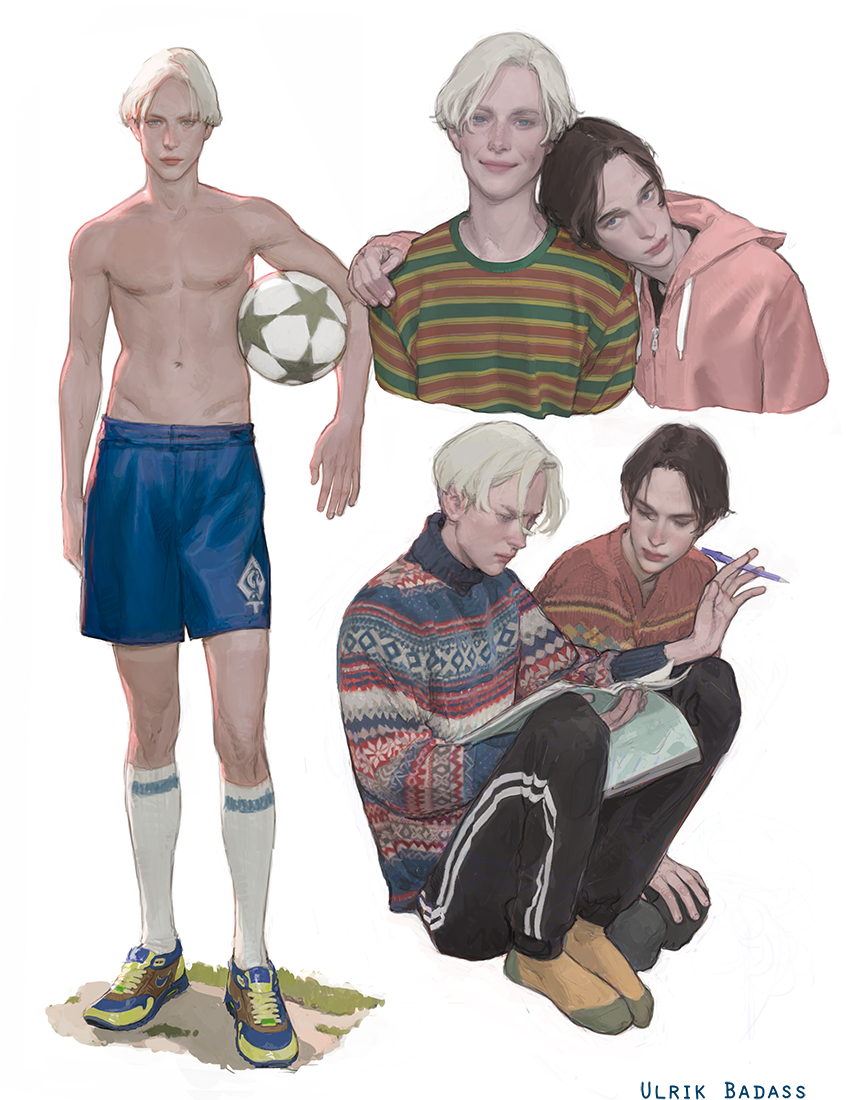
Back in his youth, Viktor didn't harbor nearly as many grudges against Ruslan. He believed that if he could only prove to his Dad that he was worthy of a father's love, then the old man would accept him just as unconditionally as he did Ruslan - the second son, born to a woman "younger and prettier." Even back in school, Viktor was already refining his flawed blond into something that passed for perfect. Only Ruslan knew that his hair was actually darker, since he was the one dyeing Viktor's roots every six weeks. Even now, nearing thirty, Viktor still fights his resentment toward the clueless Ruslan - a man with no talent, no charisma, and not even the light hair (like their father's) to show for it. And yet, Ruslan remains the only one who accepts and loves him unconditionally.